Reflecting as we go: More lessons from designing and delivering CDKN’s knowledge brokering workshops
Reflecting as we go: More lessons from designing and delivering CDKN’s knowledge brokering workshops
2025 was a busy year for CDKN in strengthening our knowledge-brokering capacities. We built on the lessons from our first two workshops in 2024 to deliver five more in 2025, shifting our attention to young people. As the year drew to a close, we took stock of these experiences and found many rich lessons emerging.
An audience-driven approach
Our first events brought together a mix of experienced researchers and practitioners, so shifting our focus to young people required inevitable changes to both our content and our facilitation. Furthermore, young people are far from a homogenous group, with our participants ranging from early career researchers and creatives in Ghana to informal settlement youth activists in Nairobi, young entrepreneurs in Ethiopia, French- and English-speaking post-doctoral fellows from across Africa, and IPCC chapter scientists representing five continents.
Across these workshops, we maintained a healthy mix of:
-
Delivering theoretical content to inspire participants – particularly those from academia – to adopt more systemic, context-driven and co-creation-centred approaches in their work.
-
Facilitating dynamic experiential activities accompanied by structured reflection processes to surface lessons tied to the content.
-
Fostering peer learning spaces focused on jointly analysing problems, testing tools and discussing solutions to overcome challenges.
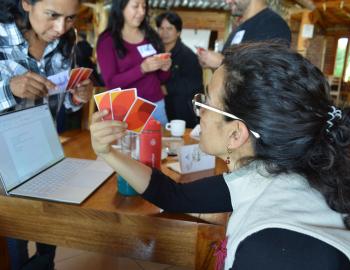
How these activities were received varied according to participants’ learning styles. Some were especially drawn to the theoretical concepts and wanted more, while others – particularly the Muungano youth activists – shared powerful reflections from the experiential exercises. What emerged clearly across all workshops is that participants valued hands-on activities, and the more closely these aligned with their own work and interests, the higher their levels of engagement and enjoyment.
In Ghana, for instance, researchers’ opportunity to collaborate with artists to translate their findings into tangible outputs (whether a painting, podcast, poem, media article or song) offered a unique and valued experience of how research can reach diverse publics. In Ethiopia, working on and pitching proposals to secure funding for their project ideas proved similarly motivating, driving participants to stay up late into the night to make the most of the chance to receive feedback from the facilitation team.
At the same time, we learned that, because people have different learning preferences, it is impossible to satisfy everyone with every activity all the time – and that is both normal and inevitable. We also saw that young people can be our most demanding and initially most sceptical audience, requiring us to deliver high-quality, impactful sessions to gain their trust and buy-in. Once they recognise the value of these activities, however, their enthusiasm becomes unmatched and these moments offer some of our most rewarding experiences.
Collaborations and co-creation are hard!
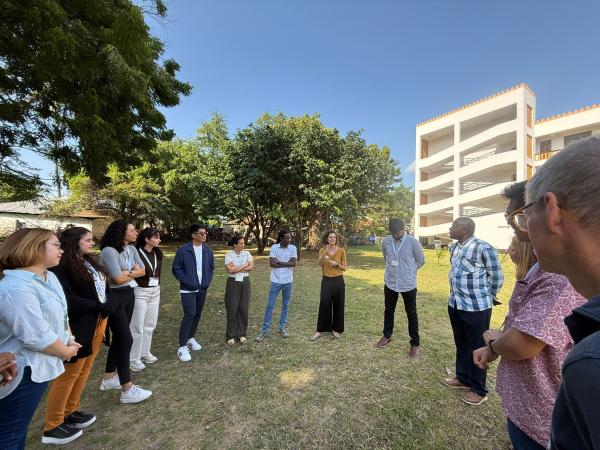
A collaborative approach underpinned our work, as we sought to maximise workshops’ usefulness by co-designing their contents and activities with participants wherever possible – or at least with the institutions requesting knowledge brokering training. Collaboration also took place within the CDKN team itself: we were guided by the requests of our country colleagues in Ghana and Ethiopia; co-delivered two workshops with CDKN’s finance and EbA thematic leads to explore how knowledge brokering can strengthen funding proposals and more equitable nature-based approaches; and worked across generations, with CDKN’s youth team increasingly becoming our most trusted workshop co-facilitators.
We also ventured further afield, co-delivering a workshop for the ASCEND postdocs with colleagues from the Red Cross Climate Centre. This collaboration offered a unique opportunity to test new experiential learning activities, approaches and games, expanding our arsenal of techniques for future learning processes. It also strengthened the ties between our knowledge brokering work and the CLARE innovative facilitation fellowship, which build on each other and are complementary in developing fellows’ capacities in a holistic way – with several fellows taking part in both initiatives.
But this was not always easy. As the person who has been the continuous thread across all knowledge brokering workshops – from their original ideation to their implementation and ongoing adaptation – I have sometimes found it challenging to stay open to entirely new ideas, let go of certain content or activities, or accept alternative ways of doing things. Relinquishing the power that comes with holding a process is difficult. At times, this meant creating space for others to facilitate activities, even when they approached them differently from how I might have.
In other instances, it meant recognising that my way is not necessarily the best way, and that making space, collaborating, and integrating diverse voices and approaches is ultimately what we advocate in our workshops. The learning lies precisely there, in practicing what we preach. I was humbled to hear that when young participants see someone like them facilitating a session or holding a space, it gives them hope that they too, one day, could be in that position – something that had not occurred to me before.
Refining our content and approaches
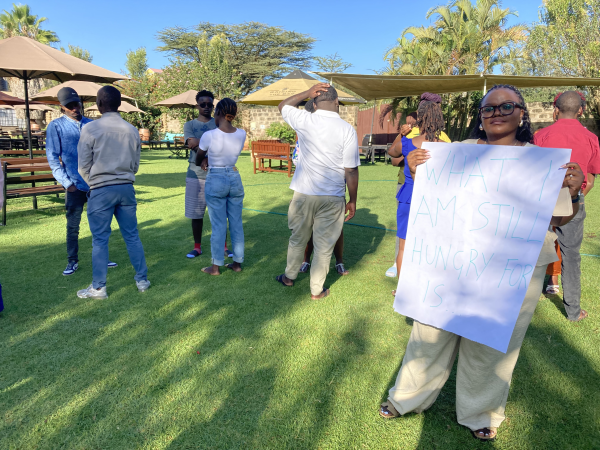
We ensured that each workshop included space to test or trial something new – whether a refined way of explaining a concept; a new tool; an experiential activity we had never facilitated; or a different closing reflection process. This allowed us to gradually add or remove activities depending on our audience, while also shifting from more foundational topics towards some of the more complex, nuanced issues that climate practitioners and researchers face.
For example, we began facilitating conversations about the power we hold, what makes us feel powerful or powerless, and the situations in which we give our power away and why. We asked participants to reflect on the motivations and values guiding their practice, how they either challenge or reinforce existing structures, and the ways in which they try to shift systems.
More and more, I realise that the success of any of our knowledge brokering work depends on how prepared we are to change ourselves first, to listen more deeply, acknowledge our blind spots, and bring genuine empathy into what we do. Drawing on Otto Scharmer’s Theory U, opening our mind to move from judgement to curiosity; opening our heart to shift from disconnection to compassion; and opening our will to act with courage are essential qualities of today’s leadership. Creating spaces for open conversations, reflecting on where and who we are, and challenging ourselves to change must be woven into our work and our workshops. We are on that learning journey.
Capacity strengthening cannot be a one-off activity
As much as possible, and through different mechanisms, we have tried to ensure that our knowledge brokering capacity strengthening does not end with a single three-day workshop – although, admittedly, this emerged more by chance than by design. We now recognise that ongoing engagement is essential and must be planned from the outset. In Ethiopia, participants were invited to submit refined funding proposals to CDKN, with three winning teams being awarded microgrants to implement their projects. In Ghana, participants have stayed connected to the facilitation team, which has linked them to numerous opportunities to share their research findings at conferences, in media outlets and other platforms. Many have also remained in touch with the creatives and artists they collaborated with, continuing to produce joint outputs.
In Nairobi, the workshop with the Muungano youth leaders formed part of a broader learning process examining how young community leaders bridge the knowledge-to-action gap in informal settlements. They too will receive three microgrants to complement the written learning with multimedia outputs that showcase their knowledge brokering work. Two follow-up learning days after the training workshop – including one held five months later – provided valuable opportunities to reinforce core concepts and ask incisive questions aimed at strengthening reflection skills and sharpening their knowledge brokering approaches for greater impact, while also gathering insights on their work.
Finally, in the case of both the ASCEND and IPCC early career researchers, in-person workshops were complemented with online sessions before and after the gatherings, which uncovered needs before and helped follow-up on gaps after participants had the chance to digest the in-person experience.
Learning is the answer
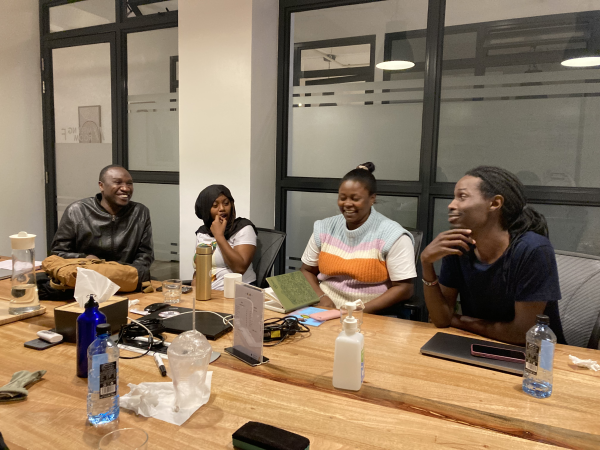
As the Many-to-Many system recently reminded me, ‘learning is the work’. I have come to understand this in different ways:
-
Learning as liberation: Our knowledge brokering capacity strengthening work has been an experiment and internal learning curve since the beginning. Seeing everything as an opportunity to test and learn allows you to let go, try new things and worry less about perfection – which is never fully attainable anyway.
-
Learning as an antidote and healing practice: As you relinquish control – sometimes by choice, often out of necessity – you begin to notice how long-standing patterns, pains, power dynamics and ego-driven behaviours surface as current teachers and guides. This helps drive us towards the type of leadership Otto Scharmer’s team is referring to.
-
Learning as transformation: The more you learn, reflect, shift and adapt, the more energised you become. The process itself can feel enlivening, almost like a release of endorphins.
Again, this may look easy on paper, but it is not. It requires testing oneself, continuously.
What is next
As CDKN approaches its final year, our focus now shifts to collating, compiling and showcasing the material we have developed. We hope to launch this by mid-2026: watch this space!
Click here to learn more about CDKN's knowledge brokering work.