
Amplifying the voices of African early-career researchers for global and regional climate leadership
Amplifying the voices of African early-career researchers for global and regional climate leadership
"In a rapidly evolving climate landscape, the leadership of early-career researchers will be essential. Initiatives that create space for their visibility, contribution, and connection are not supplementary; they are strategic investments in Africa's climate future." - Silvia Hagan, Facilitator - CDKN AVAR Fellowship
Africa is on the frontlines of the global climate crisis. Rising temperatures, erratic rainfall, devastating floods, and deepening food insecurity are reshaping lives across the continent every day. And yet, Africa's own scientists and researchers, those who understand the terrain, the communities, and the lived realities, remain underrepresented in the global conversations that determine climate policy and science. This gap has called for institutional support for Africa’s scientists, especially early-career researchers (ECRs), to produce contextualised evidence that could support effective climate policy formation and practice interventions.
As part of the Amplifying Voices for African Research project, the CDKN Africa Early-Career Researchers Fellowship was designed to confront this imbalance head-on and deliberately invest in professional scholars who will write Africa's climate story on Africa's terms.
The representation gap
The numbers paint a stark picture. In the IPCC's landmark Sixth Assessment Report, just 11% of contributing authors were from Africa. According to Dr Portia Adade Williams, IPCC AR6/AR7 contributing author, “Only 3.8% of global climate research funding is allocated to African topics, yet Africa bears a disproportionate burden of the climate crisis." This reflects a deeply embedded structural barrier. Funding priorities, peer-review panels and grant administration remain concentrated in the global North, so the institutions best positioned to win climate finance are those already embedded in those systems. African researchers are frequently brought into projects about their own regions as data collectors or junior collaborators rather than as principal investigators who set the questions, control the budgets and own the findings. The exclusion is therefore built into how research is commissioned and funded, not a matter of individual capability.
When the majority of funding for African climate challenges flows to institutions in Europe and North America, the researchers closest to the crisis are pushed to the periphery of the very conversations meant to address it. Despite growing recognition of the importance of locally grounded knowledge, research systems continue to privilege externally resourced researchers, while many African researchers face persistent barriers to funding, mentorship and visibility.
For African ECRs who are at the beginning of their professional journeys, these barriers are especially pronounced. Chronic underfunding, a lack of structured mentorship, high publication costs, institutional constraints, and a persistent disconnect between research and policy action combine to suppress some of Africa's most promising scientific voices.
The fellowship as a transformative response
In response to this significant and under-addressed gap, the AVAR Fellowship was designed as a seven-month structured programme for early-career researchers, with a highly competitive application process attracting about 1,000 applicants. About 100 researchers were selected from 16 countries across West, East, Central and Southern Africa. The Fellowship aimed to strengthen their research capacity, expand professional networks, and amplify their voices in regional and global science-policy spaces.
The Fellowship was grounded in a simple but powerful insight: the challenge facing many African ECRs is not a lack of evidence, ideas or innovation, but limited access to the platforms, resources and opportunities needed to translate research into real-world impact. To address this, the Fellowship combined a carefully integrated set of interventions, including capacity-strengthening webinars, knowledge-to-action projects, the development of podcasts, blogs, and other knowledge-sharing opportunities designed to enhance research uptake, visibility, and influence.
Building rigorous, policy-relevant research capacity
At the heart of the fellowship was a curated webinar series designed to move participants from reflection to action. Sessions were built around the themes most critical to effective climate research and engagement. The topics included:
-
African research representation in global climate platforms
-
Knowledge brokering and co-production methodologies
-
Systematic reviews and transdisciplinary research approaches
-
AI ethics and gender and social inclusion frameworks
-
Science-policy engagement pathways
-
Grantsmanship and competitive proposal development
Rather than treating these as abstract concepts, the fellowship placed application at the centre of learning. Fellows were encouraged to reflect on their own research, position it critically, and identify concrete opportunities to translate their work for broader, non-academic audiences, including policymakers and community leaders.
Bridging the science-policy divide
A recurring frustration among African researchers is the sense that their work, even though rigorous and locally relevant, fails to influence the policies that shape their communities' futures.
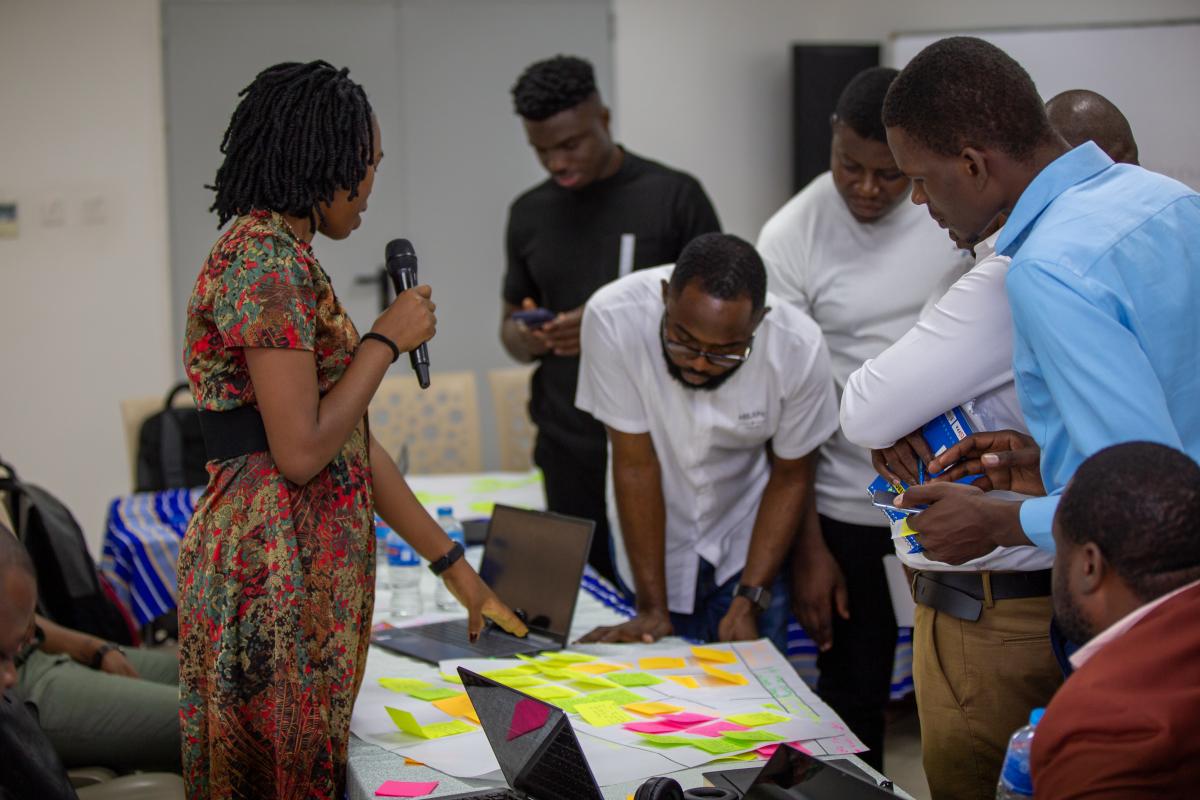
Fellows received dedicated training in systems thinking, storytelling for policy audiences, and knowledge brokering. These skills can help transform raw data into compelling narratives that decision-makers can act on. Six researchers from Cameroon, Uganda, Ghana, Tanzania, Benin, and South Africa were selected to participate in a co-creation lab session in Ghana. They were awarded grants to translate their research into accessible tools useful for institutional decision-making and community action. Each researcher formed a team of three (including a tech-creative partner and an institutional lead) to co-create adaptation tools for local-level climate action. By equipping researchers to translate their findings into accessible, actionable messages, the fellowship enhanced the capacity of ECRs to be knowledge brokers who play the role of knowledge producers, science communicators and change agents.
"Joining the fellowship was not just about resolving the challenges faced by African ECRs, including myself, but also about advancing our individual careers as researchers. This is helping to cultivate a generation of intellectuals and leaders who can write Africa's climate narratives for a more resilient future." - Agnes Gisbert Kapinga - Fellow, CDKN Africa ECR Fellowship
Elevating visibility and building a Pan-African Network
The fellowship understands that for African ECRs, visibility is itself a form of capacity. Without platforms, even the most innovative research remains invisible to the global community. The programme has addressed this by actively creating pathways for fellows to publish, share, and be heard.
The fellowship cohort has produced a remarkable body of work:
-
Seven article submissions to peer-reviewed and policy journals
-
Sixteen blog posts submitted spanning climate adaptation, governance innovation, and resilience strategies.
-
Fourteen podcast episodes providing an accessible, video and audio platform for African climate voices
These outputs are central to the fellowship's theory of change: that shifting global climate narratives and decision-making requires African researchers to be consistently visible, influential and recognised in the spaces where policies, investments and priorities are shaped. Beyond individual outputs, the fellowship has fostered a community of practice among fellows. Through platforms such as WhatsApp, the researchers continue to network, engage and share opportunities. To date, over 200 opportunities, including scholarships, funding calls, research collaborations, fellowships and job opportunities, have been exchanged across the network, reinforcing the value of peer connection.
Valuing local knowledge in global climate research
One of the most distinctive contributions of the fellowship is its explicit commitment to recognising and drawing on multiple knowledge systems - scientific, indigenous and community-based - to address climate challenges. African researchers are not simply consumers of Western scientific frameworks; they are co-creators of knowledge that integrates ancestral wisdom and local knowledge with scientific methods to generate contextually relevant, evidence-based solutions.
By validating indigenous knowledge systems alongside AI-powered climate modelling and Geographic Information Systems, some fellows produce solutions that are both scientifically rigorous and deeply contextually grounded. This synthesis of local legitimacy and global scientific credibility is precisely what has been missing from mainstream climate discourse. The fellowship creates the conditions in which it can flourish. For instance, one fellow's project in the Bamboutos Mountains of Cameroon is co-creating a sound library of climate-sensitive Orthoptera species using SwiftOne acoustic recording devices. The project integrates farmers' indigenous observations of shifting seasonal and biodiversity patterns with scientific acoustic monitoring to build a community-driven early warning tool for climate adaptation.
Looking ahead and sustaining the momentum
As we reflect on our learning from the formal fellowship period, attention is turning to sustaining and amplifying the knowledge products generated, the peer network established, and the leadership cultivated among emerging climate researchers across the continent. The peer network, a community of emerging climate leaders spanning the African continent — continues to grow through digital engagement platforms, supporting fellows well beyond the formal programme. The CDKN Africa ECR Fellowship is not a one-off intervention. It is a model that demonstrates what becomes possible when African ECRs are given training, trust and confidence to utilise their ideas and capacity to lead their communities and contribute to wider climate decision-making spaces.
Investing in African early-career researchers is not an act of charity; it is a strategic imperative. The climate crisis will not be solved by distant institutions studying Africa from afar. It will be addressed effectively, equitably, and sustainably by local researchers who understand their context, the communities, and the complex interdependencies of the systems they study. It’s more important than ever to create the conditions for African scientific leadership to thrive through structured capacity building, tangible knowledge outputs, and lasting networks.