
Building resilience or building risk? Lessons from Sapatana Ashrayan in Bangladesh
Building resilience or building risk? Lessons from Sapatana Ashrayan in Bangladesh
As part of the CDKN Knowledge Accelerator for Climate Compatible Development Programme, a team from our alliance partners, ICLEI South Asia, visited Ward 9 of Lalmonirhat Municipality in Bangladesh. The visit focused on assessing the Sapatana Ashrayan national housing project, examining how effectively it addresses climate vulnerability and livelihood challenges in this highly exposed region. In short, the team sought to answer an important question: does providing housing alone ensure long-term resilience in a changing climate? Field observations suggest that it does not.
Overview of the Ashrayan project
Sapatana Ashrayan is part of the Government of Bangladesh’s Ashrayan project, launched in 1997 to provide land and housing to landless families. Designed to support vulnerable populations through permanent housing and access to shared infrastructure, the project represents a significant national effort to address homelessness and displacement.
Over the past two decades, the project has been implemented in multiple phases across the country (see table below), reaching tens of thousands of families. According to official government reports, by mid-2024, 58 districts and 464 upazilas (sub-districts) had been declared free of landless and homeless households. This was reported in various news articles. In addition to this, five entire divisions – Dhaka, Mymensingh, Sylhet, Khulna, and Rajshahi – were also said to have achieved this goal.
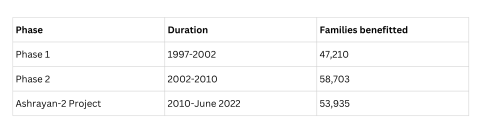
Despite the government reporting the project as successful, challenges remain in ensuring its long-term effectiveness. A significant gap persists in communities’ capacity to withstand climate-induced shocks and stresses, as the handover of housing alone has not addressed underlying vulnerabilities. Families continue to face livelihood insecurity and inadequate infrastructure, with substandard materials leading to frequent damage during rains and storms (The Financial Express, 2023). Without integrating gender-sensitive planning, locally led adaptation and livelihood support, structural inequalities persist – particularly those affecting women, children, and other marginalised groups.
The Sapatana Ashrayan housing project, which was implemented in Lalmonirhat municipality as part of Ashrayan-2, faces urgent and overlapping challenges: economic insecurity, poor quality housing and inadequate sanitation, limited livelihood opportunities, and increasing exposure to climate-related environmental and infrastructural risks. These issues were documented during a field visit by the ICLEI South Asia team, as part of the ‘Climate-Induced Disaster Risk Reduction (DRR) Action Plan for Lalmonirhat Municipality’ initiative.
Daily economic struggles
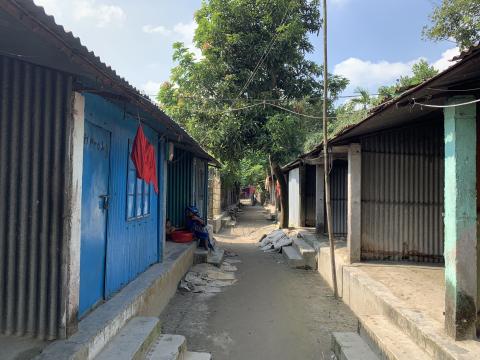
The Sapatana Ashrayan project spans approximately four hectares on the floodplain of the Teesta River, currently accommodating around 170 households. While families now have formal housing, many continue to struggle to meet their basic needs.
Livelihood insecurity remains widespread, and most residents depend on low-wage agricultural labour, small-scale cultivation, fishing, or informal work such as domestic labour. Without access to vocational training or diversified income opportunities, economic vulnerability persists. These challenges are compounded by patterns of migration. Many working-age men leave for cities such as Dhaka in search of employment, often in precarious sectors such as garment manufacturing. This leaves women, children and elderly family members behind, frequently with irregular financial support. As a result, women are often pushed into low-paid informal work while also managing household responsibilities, reinforcing gendered vulnerability.
Some of the women from these groups have expressed interest in diversifying their income opportunities. Ayesha, a young mother interviewed during the field visit, says, "If we learn a skill like sewing, we could earn from home and still take care of our children", highlighting a potential solution for improving women’s lives and financial security.
The challenges of living on a floodplain
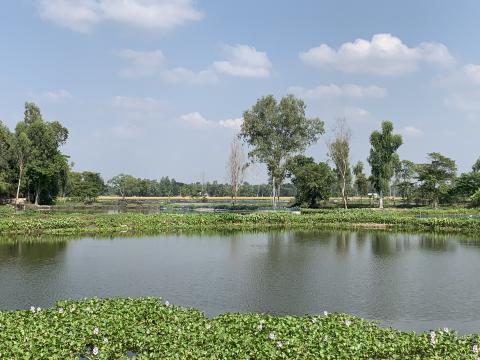
Beyond economic challenges, the settlement is highly exposed to environmental risks due to its location on a floodplain. Residents face frequent waterlogging during the monsoon season, exacerbated by inadequate drainage infrastructure and the low-lying nature of surrounding land. The housing design itself reflects a critical limitation. Standardised structures have been applied uniformly, without accounting for local environmental conditions such as flood risk, soil type or drainage patterns. This one-size-fits-all approach has created new vulnerabilities rather than reducing them.
In a country like Bangladesh, where climate risks vary significantly across regions, such design assumptions can have serious consequences. The absence of climate-responsive planning in housing development undermines the very objective of resilience. To better understand these risks, ICLEI South Asia conducted a ward-level Climate Risk and Vulnerability Assessment, as part of the DRR Action Plan. The assessment identified flooding as a high-likelihood, high-impact hazard in Lalmonirhat, particularly in Ward 9. Poor environmental management and limited maintenance of infrastructure further increase exposure to these risks.
Climate change is also affecting livelihoods directly. Rising temperatures and prolonged flooding are reducing agricultural productivity and limiting food security. As community leader Rashedul Islam Rashed noted:“We used to grow vegetables around the pond, but now, with constant flooding and rising heat, the land remains unusable for weeks. Even heat-tolerant crops are failing.” Such changes are leaving households increasingly unable to cope with environmental stress.
The pitfalls of poor infrastructure, sanitation and education
Housing challenges in Sapatana Ashrayan-2 extend beyond structural design to include basic infrastructure and services. Many households lack reliable access to clean water, sanitation, and electricity. These deficiencies significantly undermine health, well-being and overall quality of life.
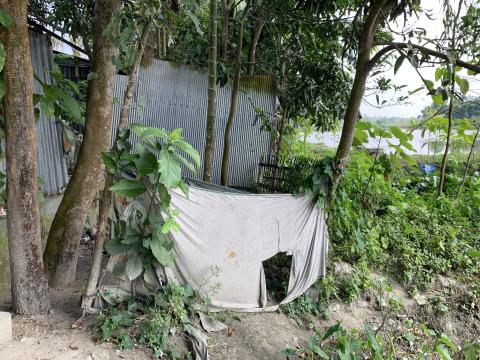
According to UN housing policy guidelines, adequate housing must include not only physical shelter but also access to essential services such as water, sanitation, drainage, electricity, and waste management. In Sapatana Ashrayan-2, these elements remain insufficient. Sanitation is a particularly critical concern. Residents rely on temporary open-pit latrines that fail to meet basic hygiene standards. During the conversation with Rashed he admitted as much, saying that “temporary open-pit latrines, constructed out of necessity, fall short of even the most basic hygiene standards.”
For women and girls, these conditions present additional risks. Limited privacy and unsafe facilities mean that some residents delay using toilets until nightfall. “I have to wait until nightfall to use the toilet for privacy,” said Khodeja, a resident of the settlement. These challenges highlight how inadequate infrastructure can reinforce gender inequality, creating disproportionate health and safety risks for women and girls.
Education is another area of concern. Many children, particularly girls, are unable to attend school regularly due to financial constraints, leading to high dropout rates. Community members have suggested introducing skill-building programmes for children and collaborating with local safety services to provide swimming training: an essential life-saving skill in flood-prone areas.
Building resilience
Despite these challenges, the residents of Sapatana Ashrayan-2 demonstrate resilience and initiative. Many are actively seeking opportunities to improve their livelihoods through skills such as sewing, embroidery, and small-scale food production. Local NGOs and civil society organisations are supporting these efforts by providing vocational training, livelihood inputs, and market linkages, significantly strengthening household income security, particularly for women and youth.
However, the experience of Shaptana Ashrayan-2 exposed significant planning and governance gaps in low-cost housing programmes. The one-size-fits-all approach of this housing design applied across diverse geographical contexts reflects limited integration of disaster risk reduction and climate considerations into planning processes. The absence of environmental impact assessments, week coordination among the line agencies, and the lack of post-handover monitoring systems have left settlements exposed to recurring flood risks, further accelerating vulnerability. Addressing these challenges requires a shift in approach.
Future housing interventions must prioritise climate-resilient design and infrastructure. Risk and vulnerability assessments should guide site selection and housing construction, ensuring that settlements are not located in high-risk areas such as floodplains without adequate mitigation measures.
Equally important is the adoption of locally led adaptation approaches. Engaging communities in hazard mapping, vulnerability assessments, and decision-making ensures that interventions reflect lived realities and local knowledge. This participatory process strengthens both the relevance and sustainability of development outcomes. Integrating gender equality and social inclusion, or GESI, into planning is also essential. Infrastructure, services and livelihood programmes must be designed to address the specific needs and constraints faced by women and marginalised groups.
In this context, ICLEI South Asia has initiated a Knowledge-to-Action (K2A) project under CDKN Phase 3 to strengthen economic resilience in Sapatana Ashrayan-2. Through targeted skill-building, provision of livelihood inputs, market linkages, and collaboration with Lalmonirhat Municipality, the K2A project translates climate risk knowledge into practical action while generating evidence to inform future housing and resilience programmes.
Conclusion
This experience highlights a critical lesson for climate-compatible development: housing alone does not equal resilience. While the Shaptana Ashrayan-2 project has addressed an urgent need for housing landless families, continuous efforts are necessary to improve living conditions, protect residents from climate risks, and create opportunities for social and economic development.
Without integrating climate risk, livelihoods, and social inclusion into planning and implementation, well-intentioned interventions risk reproducing vulnerability. However, with the right combination of community engagement, climate-informed design, and inclusive governance, such programmes can become powerful tools for building long-term resilience.
Further updates on ICLEI South Asia’s K2A project will be made available soon.