Driving inclusive climate action: Insights from Namibia’s GESI workshop
Driving inclusive climate action: Insights from Namibia’s GESI workshop
By Margaret Angula and Ester Nangolo
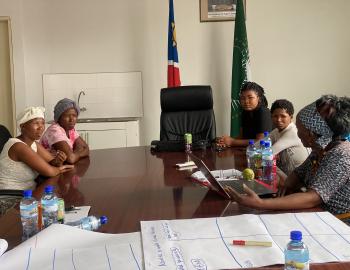
Over the past five years, the CDKN Namibia team has collaborated closely with the Ministry of Gender Equality and Child Welfare (MGECW), the Ministry of Environment, Forestry and Tourism (MEFT), Regional Councils, and the Office of the Prime Minister (OPM). Together, the team have worked to strengthen Namibia’s capacity to mainstream Gender Equity and Social Inclusion (GESI) while decentralising climate change adaptation from national to local government levels.
A new policy era: The NGEEP (2025–2035)
In March 2025, the MGECW launched the third National Gender Equality and Equity Policy (NGEEP). Succeeding the 2010–2020 framework, this new policy serves as a national rallying call to address cross-cutting issues – including disability, marginalisation, and gender-responsive budgeting. It establishes robust systems for accountability to ensure that climate mitigation and adaptation initiatives include the perspectives of all Namibians, particularly those most vulnerable to climate risks.
In alignment with this vision, the CDKN Namibia team – led by Senior Lecturer, Department of Environmental Science, University of Namibia, and CDKN Country Engagement Lead, Margaret Angula – convened technical staff from the MGECW and MEFT to develop GESI Resource Packs; practical tools designed to integrate equity into national and sub-national strategies. A core element of this process involved identifying diverse identities – such as women, people with disabilities, and marginalised communities like the San – whose lived realities are shaped by unique socioeconomic challenges. These profiles will be piloted alongside the Namibia National Adaptation Plan (NAP) in 2026.
The genesis of the GESI resource pack
Ensuring marginalised voices reach the decision-making table is more than fairness; it leads to more effective, sustainable climate solutions through increased community ownership.
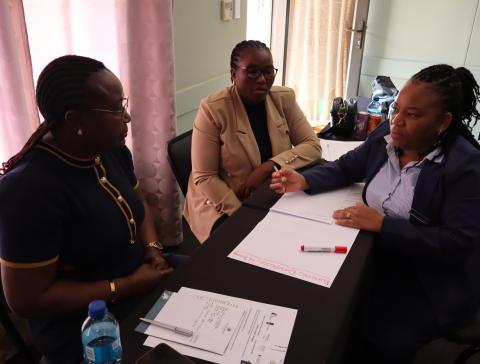
Since 2024, CDKN Namibia has engaged a broad stakeholder group, including the Namibia Nature Foundation (NNF), the Environmental Investment Fund (EIF), and gender experts from the University of Namibia (UNAM). Inspired by the success of the CDKN Ethiopia team, these collaborators formed a Working Committee to create a Namibia-specific tool. Their goal was to move beyond theory and provide practical guidance for real-world implementation.
This momentum culminated in a solution-focused workshop in Windhoek on September 23–24, 2025. The primary objective was to draft the Resource Pack materials by identifying key identities and documenting their stories.
The diversity of the participants fostered a deep sense of shared responsibility. A major milestone of the event was the identification of 45 distinct identities, 25 of which were prioritised for development into "lived reality" stories. These narratives capture the nation’s diversity and align with NGEEP goals. The relevance of this work was underscored just days later: on October 1, 2025, The Namibian newspaper featured a headline directly mirroring one of the stories shared at the workshop, confirming that the team’s focus is hitting home.
Designing localised solutions
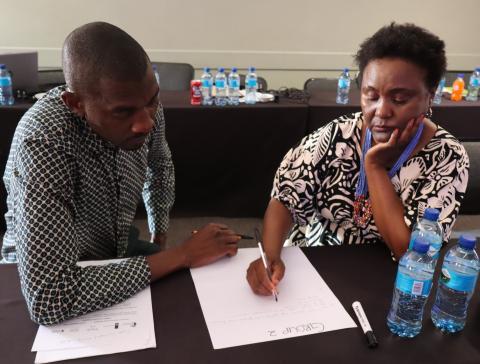
Throughout the workshop, participants moved from exploring Namibia’s Nationally Determined Contributions (NDC) to brainstorming the practical structure of the Resource Packs. Key highlights included:
-
A Step-by-Step Manual: Practitioners reached a consensus on the need for a manual to guide climate practitioners through planning, implementation, and budgeting.
-
Context is King: Participants emphasised that generic guidelines often fail Namibia's complex community structures. Resources must be customised to reflect local languages, cultures, and socioeconomic realities.
-
Intersectionality in Action: The group demonstrated that involving marginalised groups isn't just a matter of social justice—it directly results in more resilient environmental outcomes.
The roadmap ahead
The CDKN Namibia team and its partners are now finalising the GESI Resource Packs and accompanying user manual. These tools will be officially piloted during the National Adaptation Plan process in mid-2026. This initiative marks a significant step toward ensuring that climate action in Namibia is truly inclusive, valuing the voices and experiences of every community.