In conversation: Unpacking finance for resilience with Ameil Harikishun
In conversation: Unpacking finance for resilience with Ameil Harikishun
At the heart of climate, biodiversity, and development work is the question of finance. How do we ensure that resources reach the communities who need them most, and how can we align global investment with local realities? We spoke with Ameil Harikishun, CDKN’s Finance for Resilience Thematic Lead, to learn more about his work at CDKN and gain insight into how finance for resilience is helping address challenges in climate finance.
Before diving into the conversation, it’s worth understanding the breadth of Ameil’s work. In addition to his role as CDKN Finance for Resilience Lead at SouthSouthNorth, Ameil serves as a Senior Technical Advisor for Regional Learning for Non-economic Loss And Damages (RLNELD), a granting initiative that channels finance to communities to address the full range of adverse impacts that cannot be readily quantified in monetary terms. These include effects on individuals (e.g. health and well-being), on societies (e.g. cultural heritage and local knowledge), and on the environment (e.g. biodiversity loss). He is also the Senior Technical Advisor for the Generating Ambition for Locally Led Adaptation programme (GA-LLA).
This work sits within a broader shift in how we understand climate finance. To ground the conversation, it’s helpful to clarify what 'finance for resilience' means within the wider landscape of climate finance. Traditionally, a distinction has been made between adaptation finance, which helps communities manage climate risks and adapt to change, and mitigation finance, which focuses on reducing greenhouse gas emissions. Finance for resilience, as discussed below, emphasises more holistic, systems-level support for people and ecosystems facing compound risks.
In the following conversation, Robin Heuermann, Knowledge Translation Officer for CDKN, speaks to Ameil about what financing resilience really means and why it matters.
RH: Why the particular focus on resilience?
AH: Resilience has become more mainstreamed, not just in the international development and climate field, but more broadly in the public lexicon. The pandemic played a huge role in that. We started talking about resilient healthcare systems, the resilience of economies, the job market, companies, and local governments.
Suddenly, this word, which perhaps people had used more in a day-to-day sense in their own lives, became about emphasising ‘how are we responding to this?’ This is the resilience of systems that we are part of, whether it's the economy or healthcare systems.
What is our ability to respond to a global pandemic? And what it showed was how vulnerable many of our systems were to shocks and stresses.
RH: What is finance for resilience, and why is it important?
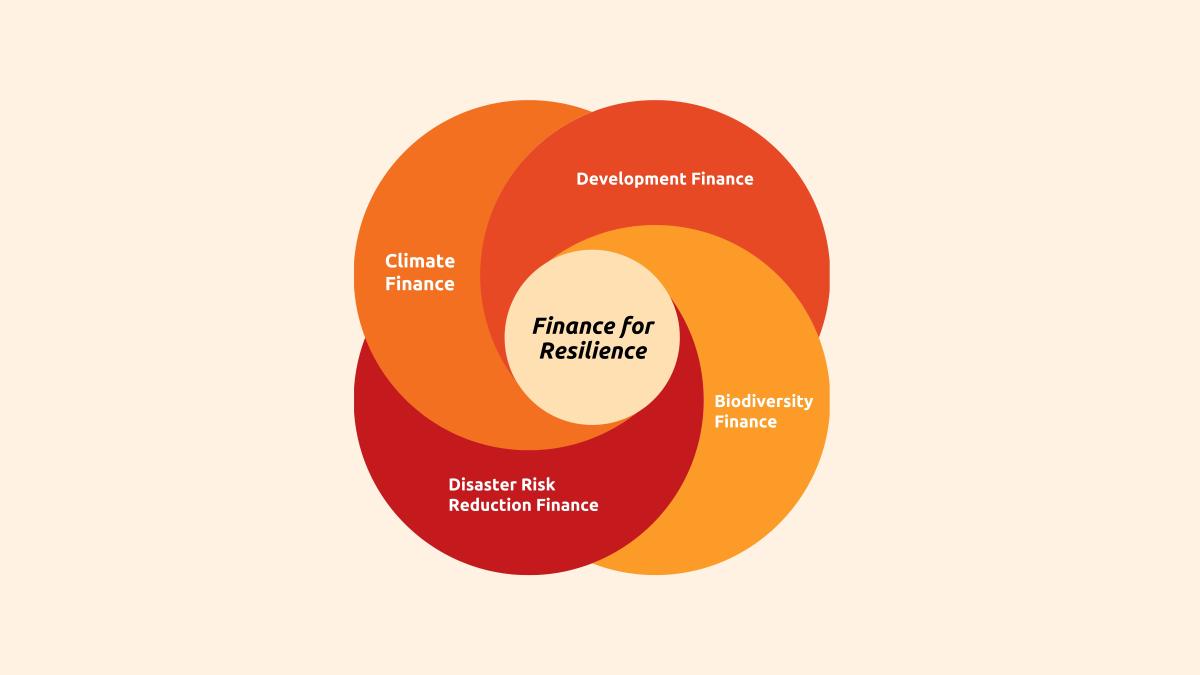
AH: Unpacking what finance for resilience is—not just ‘climate finance’ or ‘biodiversity finance’ or ‘development finance’ as separate or discrete landscapes—is essential. We're really looking at the synergistic and complementary intersection of these different channels and landscapes, as well as the architectures of finance, that move towards building resilient communities and a resilient society.
And so, finance for resilience is, in some ways, a constantly evolving idea as we continue to dig deeper into what inclusive and transformative resilience is and how it relates more broadly to the polycrisis of climate change, biodiversity loss and deepening inequality. What we want this finance to support is the building of resilient social-ecological systems that allow people and the planet to thrive within our planetary boundaries.
You have to coordinate this action. You have to coordinate these resources. It doesn't help that a country accessing climate finance to address its adaptation and mitigation needs has no biodiversity finance to address its biodiversity needs. Resilience and systems thinking allow you to bring together what have otherwise been very siloed areas of action, discourse and international cooperation.
RH: How do intersectional vulnerabilities make it more difficult to assess and deliver finance for resilience?
AH: I think it's where the rubber hits the road and why we're pushing for this very ambitious agenda that looks at systemic transformation, and why we ally with, and support, the most climate-affected communities: those that have been marginalised, disenfranchised, and underrepresented in global decision-making.
In trying to meaningfully ally with and amplify their voices, stories, and lived experiences, you realise that, at the local level, communities have a more holistic sense of their own lives. It's not just about the climate risk they’re facing; there may be much bigger shocks and stresses affecting their communities, such as conflict, tensions with neighbouring communities, or between different groups.
When you start to listen to what shapes and colours lived experiences at the local level, you realise that, while we use the lexicon of climate, development and humanitarian relief, for the people we're trying to ally with it is far more intersectional and overlapping. It is in trying to understand how we provide resources in a way that acknowledges their agency—not seeking to empower them, but creating the enabling environment for them to empower themselves.
RH: What does finance for resilience look like at an implementation level?
AH: Much of the framing, thinking, and evidence around resilience science emerged from engineering and ecology, drawing on the idea of a stable state of equilibrium. What we now refer to as the Anthropocene, a new era in which human activities are the dominant drivers of climatic and environmental change globally, signals a departure from that stability. As a result, we find ourselves in a landscape of risk and uncertainty that has not been seen on this planet for a very long time.
At the implementation level, for a long time the thinking was that building resilience was about hard infrastructure, stormwater drains or sea walls. Understanding it in that way was very limiting. You need to zoom out and recognise that infrastructure is part of a wider system, including social and information systems. You can’t build inclusive resilience without considering how a community will access the information needed to evacuate. Simply mentioning it on the radio or in an SMS is not enough.
You have to think through the lived realities of those communities and the systems available to them, what some might describe as the softer, social, cultural, socio-political, and socio-economic dimensions. When we unpack resilience from an implementation perspective, particularly around resourcing, we see that governments and development banks have long understood the need to invest in infrastructure. But when we think about inclusive and transformative resilience, we also need to invest in social systems.
Ultimately, this raises a deeper question: why are we pursuing resilience? When addressing climate change and loss and damage, what is it that people value most and do not want to lose? Often, it is the cultural, mental, and emotional aspects of life. While structures can be rebuilt, how do you replace ancestral lands, places of spiritual significance, or forms of art, culture and heritage that are integral to our shared human story?
Understanding how these systems interact, through an equity and justice lens, offers a powerful way to think about how resilience can be built across scales and contexts.
Towards a more resilient future
Stepping back from the discussion, a few key themes stand out. Finance for resilience is not just a technical term; it is a strategic lens through which we can reimagine how investments unlock opportunity, agency, and long-term well-being for communities on the frontlines of climate change and ecological loss. As this conversation has shown, moving beyond siloed approaches to climate, biodiversity, and development finance opens pathways for more equitable, context-rooted, and transformative action. When financial systems are aligned with the lived realities of diverse communities, acknowledging their strengths, vulnerabilities, knowledge, and aspirations, resilience becomes both a practice and a promise: supporting people and ecosystems to thrive together in the face of uncertainty.
For more information, please see the Finance for Resilience priority action area project page.